
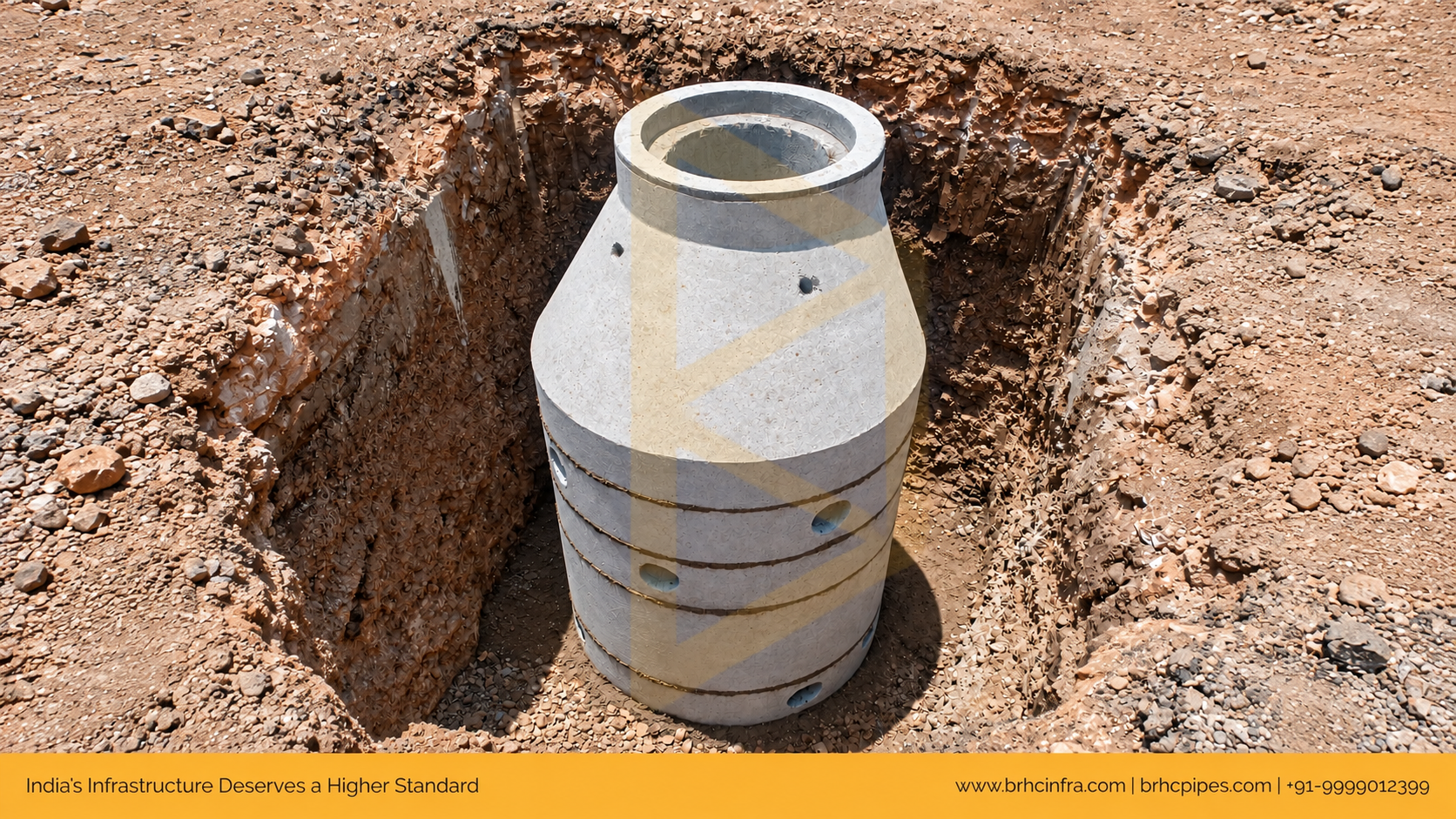
Precast Conical Manhole | Sizes, Configurations & Drawings | 1200mm to 2000mm Guide
Every sewer line, stormwater drain, or underground cable route needs a way in, a point where a technician can access the network to inspect, clear, or maintain it. In Delhi NCR, that access point is almost always a precast conical manhole: a factory-cast RCC chamber that goes into the ground already cured, already tested, and ready to carry traffic load the day it’s covered over.
Cast-in-situ construction can’t match that. Every poured-in-place sewer manhole depends on the crew, the weather, and the curing window that day: variables a busy Delhi NCR project schedule can’t always afford. Precast removes them. Each unit leaves the plant to a fixed specification, so what gets ordered is what gets installed.
Key Takeaways
- Precast manholes are available in 900 mm internal diameter for flat-type chambers and 1200, 1500, 1800, and 2000 mm for conical chambers.
- The listed configurations have 125 mm wall thickness, with 150 mm base slabs for the 900 mm flat type and 175 mm base slabs for the conical types.
- Specifications include M30 concrete, Fe-500 reinforcement, and a 560 mm cover opening, with the cover and frame selected for the required load class.
- Modular riser segments build the chamber to the required depth. Final selection depends on pipe diameter, installation depth, and site loading.
- Factory-cast sections reduce on-site shuttering and curing work. Correct bedding, joint sealing, backfilling, and cover installation remain essential.
- BRHCInfra is a leading manufacturer and supplier of precast conical manholes in Delhi NCR, offering project-specific sizing and technical drawings. For enquiries, call +91-9999012399 or email [email protected].
What a Precast Conical Manhole Is
A conical manhole is a circular RCC chamber that tapers from a wider shaft to a narrower opening at the top, sized to receive a standard precast cover and frame. It’s assembled from precast sections: a base slab with pipe openings formed in, one or more riser segments depending on depth, and a conical top section, set on a PCC bedding and jointed on site as each section is lowered into place. A flat-top configuration (without the taper) is also manufactured for shallower chambers where a reduced cover opening isn’t required.
The taper on the conical type isn’t decorative. It lets the chamber narrow to a standard-size opening at road or ground level regardless of how wide the shaft needs to be underground, keeping the surface footprint and the cover and frame consistent across different depths and diameters.

Precast Manhole Sizes
Sewer manhole diameter is selected based on the carrier pipe size and the depth the chamber needs to reach. BRHCInfra’s conical and flat-type manholes follow standard Indian precast sewer manhole sizing, built up on site in riser segments to the exact depth required.
| Type | Internal diameter (ID) | Wall thickness | Base slab thickness |
|---|---|---|---|
| Flat type | 900 mm | 125 mm | 150 mm |
| Conical type | 1200 mm | 125 mm | 175 mm |
| Conical type | 1500 mm | 125 mm | 175 mm |
| Conical type | 1800 mm | 125 mm | 175 mm |
| Conical type | 2000 mm | 125 mm | 175 mm |
Riser segments are manufactured in standard heights and stacked to reach the exact installation depth on site, so the same base configuration serves a shallow municipal chamber or a deeper trunk-line access point without a change in diameter. Cover opening is a standard 560 mm across sizes, fitted with a precast cover and frame rated to the load class the site requires, from medium duty up to extra heavy duty for carriageway and highway installations.
Concrete grade and reinforcement are manufactured to M30 and Fe-500 respectively, with clear cover maintained on both wall and base reinforcement for long-term durability in underground, often below-water-table, conditions. Access is built in with corrosion-resistant foot rests at regular vertical spacing, cast into the riser segments at manufacture rather than fixed on site.
Where Conical Manholes Get Used
Municipal sewerage and stormwater networks. Sewer manhole chambers at every junction, gradient change, and maintenance interval, the backbone use case, and the highest-volume one across Delhi NCR’s expanding drainage infrastructure.
Roads, highways, and campus infrastructure. Drainage alignments running alongside or crossing a carriageway need manholes rated to carry vehicular load, coordinated with the box culverts and U-drains forming the rest of the stormwater system.
Why Contractors and Municipal Teams Choose Precast
Consistent structural performance. Fixed reinforcement detailing and concrete grade on every unit, without the variation that comes with pouring on site.
Faster installation. No shuttering, no on-site curing wait. Riser segments are placed and jointed, built up to depth as required.
Built for load. Manufactured to carry vehicular and pedestrian traffic loads as specified, in addition to soil and groundwater pressure, to Indian standards.
Less dependent on site conditions. Manufacturing risk sits at the plant, not on a site where monsoon timing and traffic permissions already compress the schedule.

Manufactured Across Plants
BRHCInfra manufactures its precast sewer manhole range across plants in Delhi NCR and Northern India, keeping lead times shorter and logistics simpler, rather than routing every order through a single facility. As part of BRHC Concrete Industries, a precast manufacturer with a legacy dating to 1946 and ISO 9001:2015 certification, BRHCInfra brings decades of manufacturing discipline to infrastructure-grade precast.
Ordering the Right Manhole for Your Project
Manhole sizing depends on pipe diameter, installation depth, and load class: details that are easiest to confirm with drawings in hand. Share your project specifications or site details, and BRHCInfra’s team will confirm sizing and provide technical drawings before manufacturing begins.
Contact: Phone: +91-9999012399 | Email: [email protected]
